
False. PVC is not only recyclable, it can deliver performance that
closely matches virgin material in many flexible film applications
when processed correctly.
In practice, recycled-content
vinyl films often achieve
mechanical properties such as
tensile strength, elongation, and
modulus that are very similar to
virgin constructions, particularly
at common recycled levels
between 25 and 50 percent. With
disciplined sorting, processing,
filtration, compounding, and lot
control, recycled PVC becomes
a controlled formula input rather
than an unpredictable one.
What has changed is the industry’s
ability to engineer recycled
streams with precision. What has
not changed is PVC’s thermal
history. Each heat cycle consumes
stabilizers and lubricants,
which means higher recycled
percentages and tighter tolerance
constructions require thoughtful
formulation and validation. For
engineers, the question is no
longer whether PVC can be
recycled, but how to specify
and validate recycled content to
ensure performance, consistency,
and long-term reliability
Pressure to include recycled content in polymer films is rising, driven by customer sustainability goals, procurement requirements (e.g., “minimum 25% recycled”), and market differentiation. For engineers, the practical question isn’t whether recycled PVC is “good” or “bad,” but where it behaves comparably to virgin PVC, where it introduces tradeoffs, and what controls reduce risk.
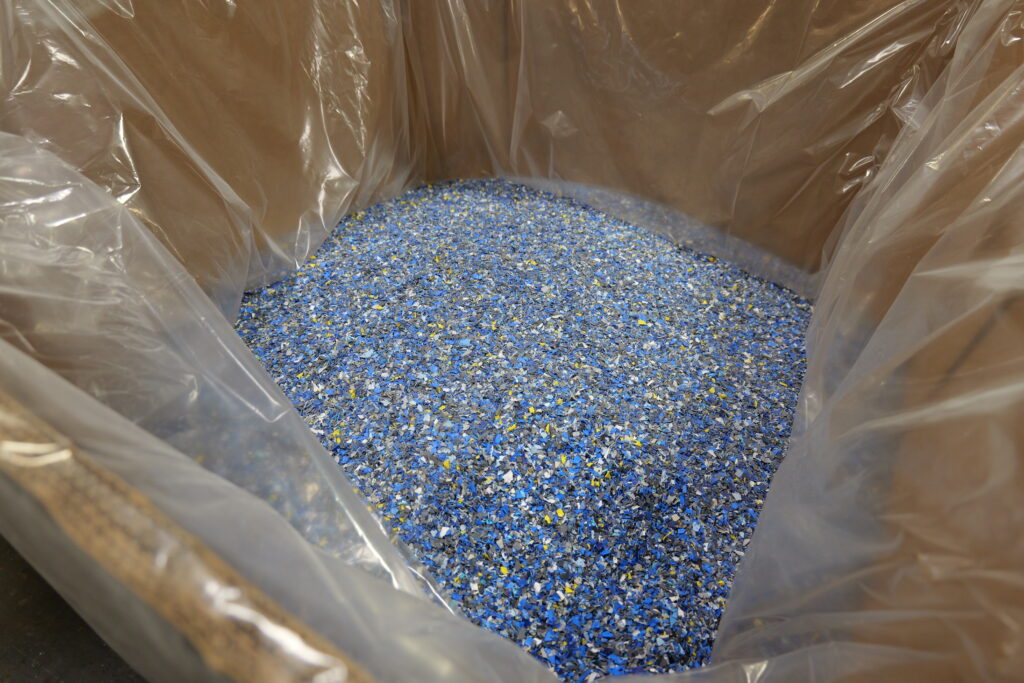
Even with modern processing discipline, recycled PVC still carries the fundamental constraints of PBV thermal history.
The most meaningful shift isn’t a new polymer miracle, it’s process engineering.
From “scrap” to controlled feedstock
Recycled content performs best when it is treated as a managed raw material stream:
• Feedstock purity and compatibility: PVC-to-PVC is workable; contamination
from other plastics is not.
• Physical form: chip/flake blends into virgin compound more uniformly than irregular chunks or “slugs.”
• Filtration: inline straining/screen packs can catch contaminants (wood chips, cardboard, dirt), but that’s a backstop, not a strategy. (One real example:
screen packs occasionally come out packed with wood and debris when scrap arrives contaminated.)
End-to-end compounding discipline
A practical advantage of in-house compounding is responsiveness:
formulations can be adjusted quickly to maintain stability, “hand” (feel/flexibility), and end-use performance as recycled batches vary. In some cases, tuned formulations can perform as well as or even better than virgin baselines, but that outcome depends on tight process control and validation, not luck.
In flexible PVC films, the mechanical property envelope (tensile, elongation, modulus) often remains very close to virgin, particularly at moderate recycled content levels and when inputs are well controlled.
Common “good-fit” conditions
Recycled-content PVC is typically a strong candidate when:
The film is more plasticized (softer/flexible).
Softer PVC tends to reprocess more easily because it generates less frictional heat and already contains more plasticizer, helping flow and stability.
Recycled content is blended with virgin (e.g., 25–50% range).
A recurring production observation: virgin compound can “carry” recycled content through the process, supporting stability and maintaining performance.
The manufacturer combines internal lab validation with disciplined process control.
When teams can characterize recycled inputs, adjust formulations in real time, and verify performance against spec, recycled content becomes far more predictable and repeatable at scale.
A recycled-content PVC waterproofing membrane, such as a ReNew Shower Pan Liner, is validated against ASTM D-4551, the standard specification for
PVC shower pan liners used in concealed waterproofing applications. Rather than treating recycled content as a marketing claim, the material is tested against the same performance criteria required of virgin constructions.
| Property | Value | Test Method |
|---|---|---|
| Tensile Strength | ≥ MD 80 / TD 80 | ASTM D-4551 |
| Elongation at Break | ≥ MD 300 / TD 300 | ASTM D-4551 |
| Tear Resistance | ≥ MD 250 / TD 250 | ASTM D-4551 |
| Low Temperature Flexibility | Pass (3 of 3) | ASTM D-4551 |
| Dimensional Stability (% Δ Max, 212°F for 5 Minutes) |
≤ 5.0% MD | ASTM D-4551 |
| Distilled Water Extraction (% Weight Loss, Max.) |
≤ 1.0% | ASTM D-4551 |
| Thickness | 40 mil (±5%) | ASTM D-4551 |
For recycled-content constructions, these properties are verified through the same qualification testing used for virgin material, with results falling within the same performance range:
| Property | Value | Test Method |
|---|---|---|
| Recycled Tensile Strength | ≥ 80 lbs (MD/TD) | ASTM D-4551 |
| Recycled Elongation | ≥ 300% (MD/TD) | ASTM D-4551 |
| Recycled Tear Resistance | ≥ 250 lbs (MD/TD) | ASTM D-4551 |
The engineering takeaway is clear. Recycled content is not validated by intention. It is validated against ASTM performance thresholds. If the product meets ASTM D-4551, it performs to the same industry-recognized standard required for concealed waterproofing membranes, regardless of recycled percentage. This means high performance and reduced environmental impact can be achieved together, not separately.
When recycled PVC “doesn’t match virgin,” the short list of culprits is consistent across facilities: appearance, process window, and tight-tolerance constructions.
Typical ΔE tolerance bands: virgin vs recycled. Color is where recycled content usually shows up first.
This matters most in products where the substrate color influences the final printed visual outcome (patterns, marbles, translucents).
What this means for specifications: If a customer demands virgin-like whiteness and ultra-tight ΔE, recycled content may still be viable, but engineers should expect additional color control work (and potentially a negotiated tolerance band).
Color and appearance: the most common limitation.
Color is where recycled content usually shows up first.
• In a virgin white film, a typical tight tolerance might be ΔE ≈ 1.0 MAX.
• In a 25% recycled construction, it may be necessary to relax color tolerance
(e.g., ΔE 2–3) due to batch-to-batch recycled color variability and reduced thermal stability.
Firmer and thinner films are more sensitive.
As PVC constructions move toward semi-rigid/firm and thin gauge, recycled content becomes harder to run defect free. Rigid PVC (or near-rigid film) has less plasticizer “forgiveness,” tighter processing windows, and a greater tendency to show degradation symptoms (color shift, defects) as recycled percentage increases.
Mixed-stream scrap can damage properties even if it “processes”
Mixing unlike with unlike (e.g., pressure sensitive scrap blended into pool-liner
scrap) can technically melt and form sheet, but it may alter “hand,” plasticizer balance, and end-use performance. The manufacturing rule of thumb is simple: stay like-to-like whenever possible.
Practical methods used to stabilize batch-to-batch outcomes
Sort scrap by color families to create closer starting blends. Better sorting reduces pigment correction needs (and cost).
Process appropriately to homogenize feedstock (avoid “slugs” and color streaking).
Lab test before production runs. A common workflow: take a sample of the blended recycled lot, mill it, and determine pigment additions needed for that
specific lot.
Lot discipline: run multiple orders against the same recycled lot, maintaining traceability and consistency.
Pre-check “hand” (flexibility) and adjust the virgin portion of the formulation if recycled input shifts stiffness/feel.
If recycled content is being considered, validation should match the risk profile of the application. Baseline against the virgin control (same construction, same tests). Validate both processability (defects, stability, color) and functional performance (mechanical + environment-specific).
FLEXIBLE PVC FILM TEST SET
• Accelerated light aging (QUVA)
• Tensile/elongation/modulus
• Tear resistance (Graves tear)
• Dimensional stability (shrinkage), lay flat
• Low temperature impact (cold crack), snap
back, racetracking
• Volatility, thickness, density/specific gravity
• Soapy water extraction
• Print abrasion (Taber)
• Mildew resistance & pink stain (outside labs)
• CaCO₃ confirmation (<3%) for higher
specific gravity (outside lab)
• Additional: peel strength, chlorine & bromine
resistance, water whitening
PRESSURE-SENSITIVE FILM TEST SET
• Tensile/elongation/modulus
• Specific gravity
• Dimensional stability
• Opacity, gloss (60°)
• Surface tension (dynes)
• Smoothness (Sheffield & Ra)
Engineering Takeaway
Recycled content doesn’t reduce the need for testing, it increases the value of comparative testing and lot-based validation.
Use this as a quick engineering screen before committing to recycled
content targets.
Recycled Content
Project Certification
Application
A notable case involved a PVC roofing walkway containing 50% recycled content used on a commercial project that achieved LEED Gold. The film delivered durability (protecting the roof membrane) while reducing carbon footprint versus virgin alternatives, illustrating how recycled content can support project-level goals without trading away functional performance when the product and validation match the application.

A useful, engineering-grounded answer is:
PVC is a forgiving polymer in recycling contexts, but it still obeys thermal history. The best
outcomes come from treating recycled content not as a checkbox, but as an engineered
component with defined controls, testing, and limits.
Work with i2M’s technical team to evaluate performance requirements, recycled content goals, and manufacturing feasibility.
We use cookies to improve your experience on our site. By using our site, you consent to cookies.
Manage your cookie preferences below:
Essential cookies enable basic functions and are necessary for the proper function of the website.
These cookies are needed for adding comments on this website.
Google reCAPTCHA helps protect websites from spam and abuse by verifying user interactions through challenges.
Google Tag Manager simplifies the management of marketing tags on your website without code changes.
These cookies are used for managing login functionality on this website.
Statistics cookies collect information anonymously. This information helps us understand how visitors use our website.
Google Analytics is a powerful tool that tracks and analyzes website traffic for informed marketing decisions.
Service URL: policies.google.com (opens in a new window)
You can find more information in our Cookie Policy and Privacy Policy.