Why U.S. Manufacturing Matters More Than Ever
Why U.S. Manufacturing Matters More Than Ever
Resilient Supply Chains Start at Home
Global supply chains are under more pressure today than at any point in recent history. From pandemic-related shutdowns and port congestion to geopolitical instability and rising transportation costs, manufacturers across industries have been forced to confront a hard truth: offshoring introduces risk.
For decades, outsourcing production overseas was viewed as a cost-saving strategy. Lower labor costs and global sourcing promised efficiency. But recent disruptions have exposed the downside of that approach—long lead times, unpredictable delays, quality inconsistencies, and vulnerability to events far beyond a company’s control.
Today, the conversation has shifted. Resilient supply chains start at home, and U.S. manufacturing is no longer just a patriotic ideal—it is a strategic advantage.
This article explores why domestic manufacturing matters more than ever, the risks associated with offshoring, the economic and operational benefits of reshoring, and how companies like i2M are helping rebuild American industrial strength through U.S.-based polymer film manufacturing.
The Global Supply Chain Reality: What Changed?
The modern global supply chain was built on assumptions of stability: open borders, predictable transportation, and steady international cooperation. Those assumptions no longer hold.
In the last several years, manufacturers have faced:
- Port backlogs and container shortages
- Volatile shipping costs
- Raw material shortages
- Labor disruptions overseas
- Foreign policy uncertainty and tariffs
- Increased exposure to geopolitical conflict
Each of these issues compounds risk. When production is thousands of miles away, companies lose visibility and control over timelines, quality, and responsiveness.
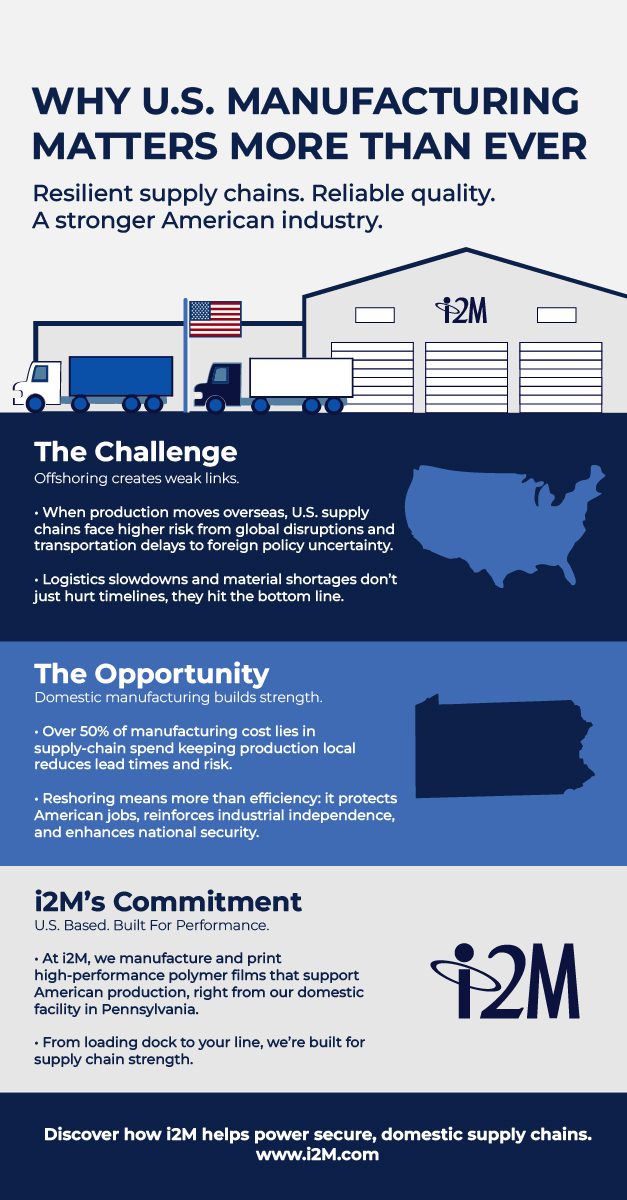
Offshoring creates weak links—and when one link breaks, the entire supply chain feels the impact.
The Challenge: How Offshoring Weakens Supply Chains
Increased Risk of Disruption
When production moves overseas, supply chains become longer and more complex. Every additional step—from international shipping to customs clearance—introduces another point of failure.
Global disruptions don’t just cause delays; they ripple across entire industries. A single factory shutdown or port closure can halt production for weeks or months.
Transportation Delays and Rising Costs
International logistics are vulnerable to congestion, fuel price volatility, and capacity shortages. Ocean freight delays can derail production schedules, while air freight costs can quickly erase any labor savings gained offshore.
For manufacturers relying on just-in-time inventory models, these delays are especially damaging.
Reduced Quality Control
Distance makes oversight difficult. When production is offshore, quality issues are harder to identify and correct quickly. This can lead to higher scrap rates, inconsistent performance, and customer dissatisfaction.
Exposure to Policy and Trade Uncertainty
Tariffs, trade restrictions, and shifting foreign policy can instantly change cost structures. What once seemed like a low-cost sourcing option can become financially unsustainable overnight.
The Opportunity: Why Reshoring Builds Strength
Reshoring manufacturing is not simply about reducing risk—it is about building a stronger, more competitive industrial foundation.
Supply Chain Spend Is the Real Cost Driver
More than 50% of total manufacturing costs often reside in supply chain spend—not labor alone. Transportation, inventory carrying costs, delays, and inefficiencies add up quickly.
By keeping production domestic, companies can:
- Shorten lead times
- Reduce inventory buffers
- Improve forecasting accuracy
- Lower logistics and expediting costs
Faster Lead Times, Greater Agility
U.S.-based manufacturing allows companies to respond quickly to market changes, design updates, and customer demand fluctuations.
Shorter lead times mean faster product launches, quicker replenishment, and improved customer satisfaction—key advantages in competitive markets.
Improved Quality and Process Control
Domestic manufacturing enables closer collaboration between engineering, production, and quality teams. Issues can be identified and resolved in real time, improving consistency and performance.
This level of control is especially critical for high-performance materials, such as polymer films used in construction, interior surfaces, pool and spa applications, and industrial environments.
The Economic Impact of U.S. Manufacturing
Supporting American Jobs and Communities
Reshoring manufacturing directly supports American workers and strengthens local economies. Manufacturing jobs often have a multiplier effect—supporting additional roles in logistics, maintenance, engineering, and services.
Reinforcing Industrial Independence
Domestic production reduces reliance on foreign suppliers for critical materials and components. This independence is increasingly important as industries face global uncertainty and supply chain volatility.
Enhancing National and Economic Security
Manufacturing capacity is a strategic asset. From infrastructure materials to advanced polymers, maintaining domestic production capabilities helps protect against shortages and disruptions that could impact national security and economic stability.
Why Domestic Manufacturing Matters in Advanced Materials
Not all manufacturing is equal. For advanced materials like decorative and functional polymer films, precision, consistency, and performance are non-negotiable.
These materials are often used in demanding environments where failure is not an option—such as:
- Kitchen and bath wall
- Pool and spa liners
- Construction and building materials
- Interior decorative surfaces
- Industrial and transportation applications
Domestic manufacturing ensures tighter control over formulation, extrusion, printing, and finishing processes—resulting in better-performing products and more reliable supply.
i2M’s Commitment to U.S.-Based Manufacturing
At i2M, domestic manufacturing is not a marketing claim—it is a core operating principle.
Built in the U.S. for Performance
i2M manufactures and prints high-performance polymer films entirely in the United States. By keeping production domestic, i2M provides partners with:
- Greater supply chain control
- Faster and more reliable lead times
- Consistent quality and performance
- Reduced exposure to global disruptions
From film extrusion and calendering to advanced printing and finishing, every step is engineered for speed, precision, and durability.
Innovation-Driven Manufacturing
Domestic production enables i2M to innovate quickly. Design, engineering, and manufacturing teams work closely together, accelerating development cycles and ensuring new solutions meet real-world performance demands.
This innovation-driven approach is critical for industries where aesthetics, durability, and compliance intersect.
From Loading Dock to Production Line
i2M’s U.S.-based operations allow for seamless coordination from raw material intake to finished product delivery. This end-to-end visibility reduces delays, improves responsiveness, and strengthens supply chain reliability for customers.
The Role of Domestic Manufacturing in Sustainability
While reshoring is often discussed in terms of economics and risk, it also plays a role in sustainability.
Shorter supply chains mean:
- Reduced transportation emissions
- Less packaging waste
- Improved material efficiency
- Greater accountability in production practices
Domestic manufacturers are also subject to stricter environmental and safety regulations, helping ensure responsible production standards.
Reshoring Is Not About Going Back—It’s About Moving Forward
Reshoring is sometimes framed as a return to the past. In reality, it represents a forward-looking strategy built on technology, automation, and innovation.
Modern U.S. manufacturing is:
- Highly automated
- Data-driven
- Quality-focused
- Innovation-led
Companies like i2M demonstrate that domestic production can be both competitive and cutting-edge—delivering performance without sacrificing reliability.
Building Resilient Supply Chains Together
The past several years have made one thing clear: supply chain resilience is no longer optional. Companies that prioritize control, transparency, and reliability are better positioned to succeed in an unpredictable world.
By choosing U.S.-based manufacturing partners, businesses can:
- Reduce risk
- Improve speed to market
- Strengthen quality assurance
- Support domestic industry
At i2M, resilient supply chains start at home. Through U.S.-based polymer film manufacturing, innovation-driven processes, and a commitment to performance, i2M helps partners build stronger, more secure supply chains—today and for the future.
Final Takeaway: Why U.S. Manufacturing Matters More Than Ever
Offshoring promised efficiency, but it delivered vulnerability. Reshoring offers something more valuable: stability, strength, and control.
U.S. manufacturing matters because it:
- Reduces supply chain risk
- Improves speed and reliability
- Strengthens the American industrial base
- Supports innovation and quality
- Enhances long-term competitiveness
As industries adapt to a changing global landscape, one conclusion is clear: resilient supply chains start at home.


Related Posts

Choosing Between PETg and Polycarbonate (PC) Film: A Practical Guide