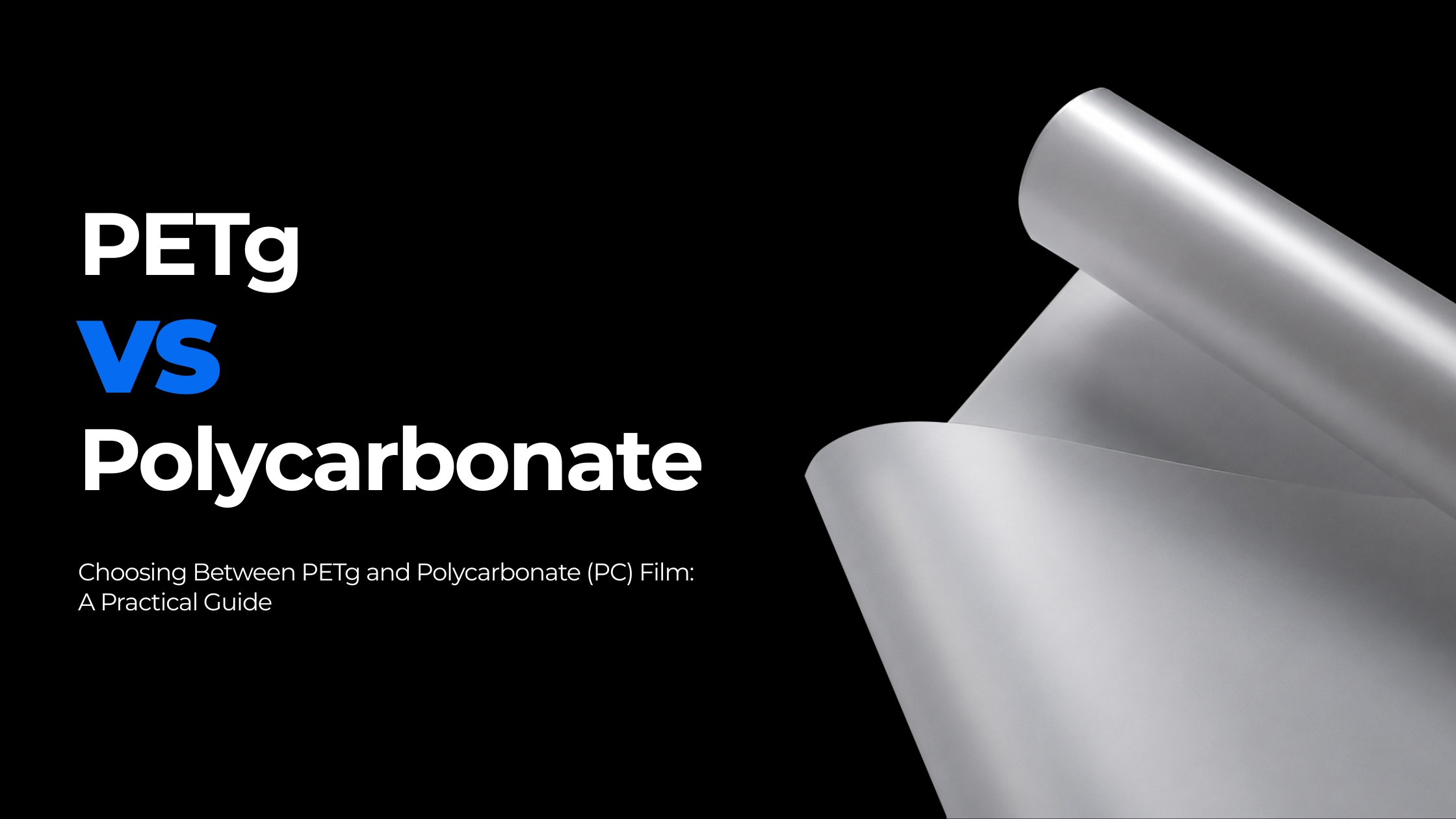
Choosing Between PETg and Polycarbonate (PC) Film: A Practical Guide
Choosing Between PETg and Polycarbonate (PC) Film: A Practical Guide
When you are specifying a clear or printable film, PETg and Polycarbonate (PC) are often two of the first materials considered. Both are proven options for flexible and rigid film applications. Both support printing and thermoforming. Both are used across industries ranging from packaging and signage to industrial components.
Their performance characteristics, however, are different.
The right material comes down to the demands of the application, including impact resistance, temperature exposure, cost targets, processing requirements, and optical clarity.
At i2M, we manufacture both iXon™ PETg and iXon® Polycarbonate (PC) Films in-house. That gives our team the ability to evaluate the application first and help customers determine which material is the best fit for their project.
The Quick Answer
For a cost-effective, easy-to-process film with good clarity for general-purpose applications, PETg is usually the right choice.
For applications that require high-impact resistance, performance through temperature swings, or greater structural durability, Polycarbonate (PC) is typically the better fit.
The comparison below provides a closer look at how the two materials perform.
Where PETg and Polycarbonate (PC) Are Similar
PETg and Polycarbonate (PC) share several characteristics, which is why the material decision is not always obvious:
- Both offer strong optical clarity for applications where appearance matters.
- Both can be thermoformed, printed, and fabricated using similar processing methods.
- Both are widely used in film and sheet form across consumer, industrial, and packaging applications.
The differences become clearer when the materials are exposed to impact, heat, weather, and repeated stress.
Where They Differ
Impact Resistance and Toughness
Impact resistance is one of Polycarbonate (PC)’s strongest performance advantages. It is one of the toughest clear plastics available and can resist cracking or shattering under significant impact.
PETg provides reliable durability for general handling and everyday use. Applications involving repeated stress, drops, or high-impact conditions will typically benefit from Polycarbonate (PC)’s added toughness.
Clarity and Optical Properties
Both materials offer excellent clarity. Polycarbonate (PC) tends to maintain its performance more effectively in applications exposed to UV light or outdoor conditions when it is UV stabilized.
PETg can provide an advantage in certain gloss and finish applications where a warmer, glass-like appearance is preferred. It is also well suited for applications that do not require the higher impact or temperature performance of Polycarbonate (PC).
Cost and Processing
PETg is generally more cost-effective and easier to process at scale. This makes it a strong option for projects where budget, throughput, and processing efficiency are priorities.
Polycarbonate (PC) carries a higher material cost, but its added impact and temperature performance can justify that investment in more demanding applications.
Temperature Performance
Polycarbonate (PC) has a higher heat deflection temperature, allowing it to maintain its shape and performance in higher-temperature environments.
Applications that will experience sustained heat exposure will typically be better suited for Polycarbonate (PC).
Typical Applications
- PETg is commonly used in retail packaging, point-of-purchase displays, general signage, wall coverings, financial cards, and applications where clarity, processing efficiency, and cost control are priorities.
- Polycarbonate (PC) is commonly used for security and identification cards, instrument clusters, medical device panels, labels and tags, high-durability signage, and applications that must withstand rough handling or demanding conditions over time.
Selection Guide
| Application | Recommended Material | Why |
| Retail packaging and POP displays | PETg | Cost-effective, strong clarity, easy to process |
| Outdoor signage with moderate exposure | Polycarbonate (PC) | Selection depends on expected impact and weather exposure |
| Protective glazing and machine guards | Polycarbonate (PC) | Superior impact resistance |
| High-heat environments | Polycarbonate (PC) | Higher heat deflection temperature |
| General thermoformed parts | PETg | Easier processing and lower cost |
| High-durability outdoor applications | Polycarbonate (PC) | Better long-term impact and UV performance |
Frequently Asked Questions
Is PETg the same as Polycarbonate (PC)?
No. PETg and Polycarbonate (PC) are both clear, thermoformable plastics used in similar applications, but they have different chemical structures and performance characteristics.
Polycarbonate (PC) provides significantly greater impact resistance. PETg is generally more cost-effective and easier to process.
Which is more durable, PETg or Polycarbonate (PC)?
Polycarbonate (PC) is the more durable option for applications requiring impact resistance and long-term performance under stress.
PETg performs well in general-purpose applications but is not designed for the same level of impact or exposure to extreme environments.
Can PETg and Polycarbonate (PC) film be recycled?
Yes. Both PETg and Polycarbonate (PC) are recyclable, which can make either material worth considering when sustainability is part of the selection process.
Does Polycarbonate (PC) cost more than PETg?
Generally, yes. Polycarbonate (PC)’s added impact resistance and temperature performance typically come with a higher material cost.
PETg remains a preferred option for applications that do not require those higher performance characteristics.
Which One Is Right for You?
PETg is a strong choice for cost-efficient, general-purpose applications. Polycarbonate (PC) is better suited for projects where impact resistance and heat performance are critical.
Once the operating conditions, processing requirements, and performance expectations are defined, the right material is usually clear.
Need help evaluating your application? Talk to our team. We manufacture both materials in-house and can help match the right film to your project’s real-world requirements.
Explore our film lines:
- iXon™ PETg | Thermoformable PETg Plastic Sheet Manufacturer
- iXon® Polycarbonate (PC) Films | High-Impact, Printable PC Films
While PETg and polycarbonate serve structural and functional needs, decorative film continues to evolve too, see what’s next in decorative film.


Related Posts
Why We Invest in Our Workforce — and Why It Matters for Your Supply Chain